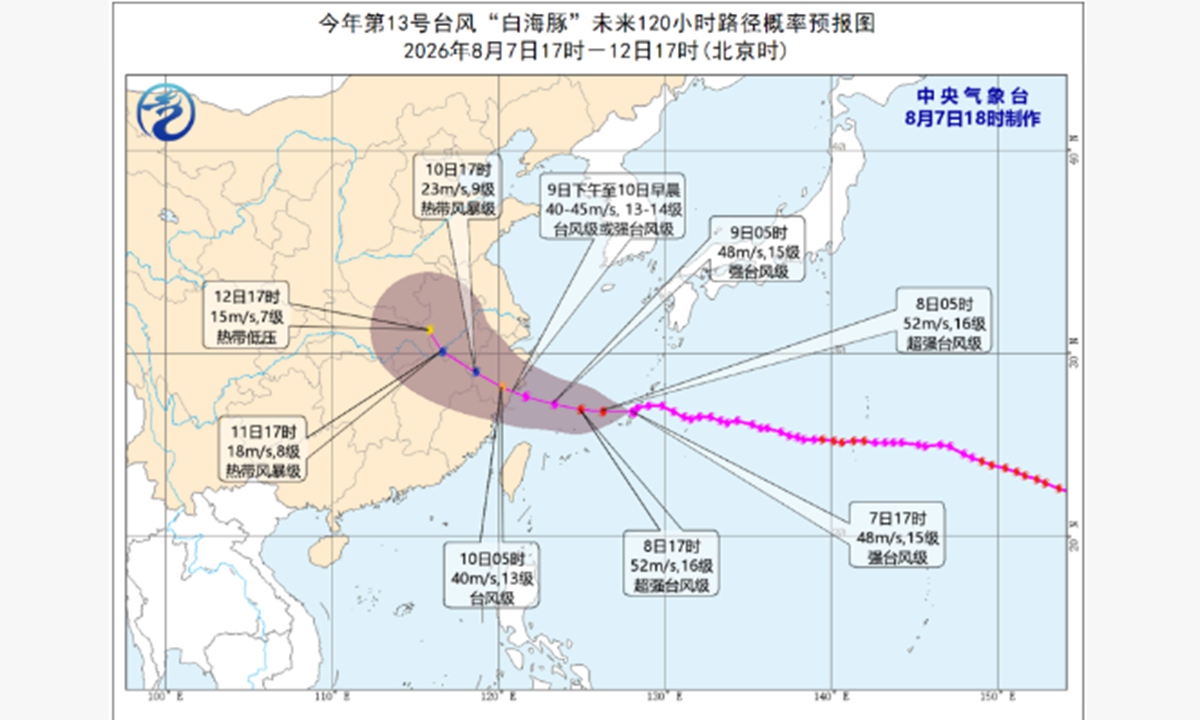
A 120-hour forecast track probability map for Typhoon Dolphin from 5 pm on August 7 to 5 pm on August 12. Photo: National Meteorological CenterMultiple national departments and local authorities have activated emergency response measures as Typhoon Dolphin, the 13th typhoon of 2026, approaches China's eastern coast, in an effort to safeguard people's lives and property. China's National Meteorological Center (NMC) continued to issue a yellow alert for Typhoon Dolphin at 6 pm on Friday. As of 5 pm, the center of the typhoon was about 730 kilometers east of Wenzhou of East China's Zhejiang Province. It was packing maximum sustained winds of 48 meters per second (Level 15) near its center, with a minimum central pressure of 940 hectopascals. According to the NMC's tropical cyclone classification, Dolphin is classified as a severe typhoon. Dolphin is expected to move westward at a speed of about 15 kilometers per hour while continuing to intensify. It is forecast to enter the East China Sea on Friday night and make landfall along the coast from Zhejiang Province to northern Fujian Province between Sunday afternoon and Monday morning. After landfall, it is expected to move west-northwestward and gradually weaken, according to the NMC's forecast. At 6 pm on Friday night, China's Ministry of Water Resources launched a Level IV emergency flood response for Shanghai and the provinces of Jiangsu, Zhejiang, Anhui, Fujian and Jiangxi. The Ministry of Natural Resources activated a Level III marine disaster emergency response for Zhejiang, a level IV response for Shanghai, Jiangsu, and Fujian, and convened a meeting on Friday to coordinate marine and geological disaster prevention and response efforts for Typhoon Dolphin, making comprehensive arrangements for disaster preparedness, the Xinhua News Agency reported on Friday, citing the two ministries. Coastal provinces have been stepping up preparations as Typhoon Dolphin approaches. According to Xinhua, authorities in Zhejiang Province upgraded emergency responses for Typhoon Dolphin from Level IV to Level III at noon on Friday. Fujian Province also upgraded its emergency response to Level III, according to provincial authorities. Typhoon Dolphin is expected to bring strong winds and heavy rainfall to parts of eastern China. According to Xinhua, from Friday to Tuesday, Zhejiang, Fujian, Jiangxi, Jiangsu, Shanghai and Anhui are forecast to receive heavy to torrential rain, raising the risk of flooding in major river basins and smaller rivers. Fujian authorities have also suspended some ferry and passenger transport services and closed tourist attractions in parts of the province as a precaution. Xu Yinglong, chief forecaster at the NMC, said Typhoon Dolphin is currently being influenced by a combination of the subtropical high, the westerly trough-ridge system and multiple tropical systems, leaving some uncertainty over its track after landfall. Tropical disturbances over the Beibu Gulf and the western Pacific could also affect Dolphin's development and path, according to the official WeChat account of the China Meteorological Administration. As Dolphin approaches China's eastern coast, impacts from wind and rain are expected to intensify. Xu said the typhoon could bring stronger localized winds than Typhoon Bavi, the ninth typhoon of this year, while producing heavier and more widespread rainfall, with some areas likely to experience extreme precipitation. From Friday to Saturday afternoon, waves of 7 to 13 meters are forecast in the East China Sea, while waves of 4 to 6.5 meters are expected in the coastal waters off Zhejiang. The coastal waters off Shanghai and northern Fujian are forecast to see waves of 3 to 4.5 meters. Meanwhile, storm surges of 50 to 120 centimeters are expected along the coast from the Yangtze River estuary to Fuzhou in Fujian Province from Friday afternoon to Saturday afternoon, the Global Times learned from the National Marine Environmental Forecasting Center. Global Times 。



 Humanoid robots, autonomous vehicles speed up China's parcel delivery
 台湾南部强降雨致271件淹水灾情 多地24日停班停课
 Xbox记者称赞《巫师3》重制版:大幅更新含海量新内容 并为第三款扩展包预热
 Hong Kong population rises 0.3% as inflows offset natural decrease
 建德“轻极限运动月”周末开启 水陆空全域联动十项赛事等你来
 辽宁省第二届职业技能大赛在大连开幕


